


Wellbeing


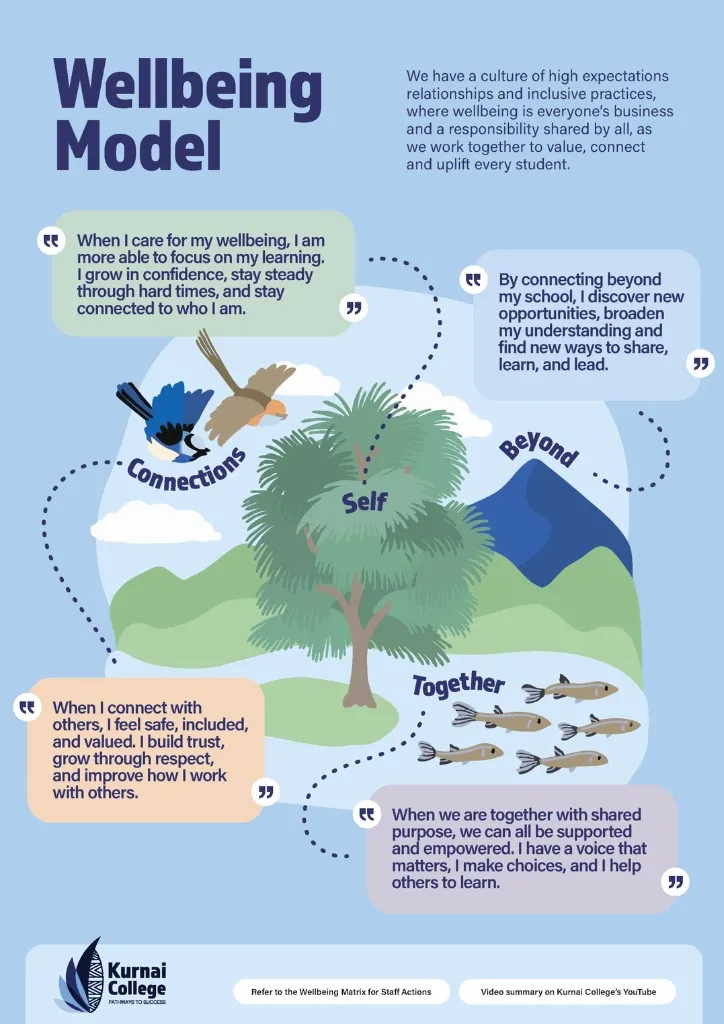
Wellbeing Model


We have a culture of high ex

Wellbeing Supports


Whilst we prioritise academic growth and learning outcomes, students sometimes require extra support with their wellbeing to help make the most of their education and achieve their full potential.

At Kurnai College, we support our students, teachers and families in a number of different ways with access too:

Advocates

Our Advocate teams are located on each campus across the college and comprise of teaching staff and education support staff to provide a supervised space to support students and remove barriers to learning including providing food, uniform support, and facilitate positive relationships around the school.

Times when students may want to speak to the student advocates:

What the advocates can do for students:

Welfare Supports

Each campus has a Student Welfare Officer who works closely with students and teachers to form strong relationships and offer specialised support. Through welfare support, they assist students and their families with a range of needs, including mental and physical health, emotional well-being, relationships, stress and behaviour management, organisation, communication, and social and interpersonal skills. They often make referrals and link with appropriate external agencies for physical and mental health, housing, finances, transport, food, emergency relief, parenting and family support, pathways, alternative programs, and provide advocacy when required.

Mental Health Practitioners (MHP)

The college Mental Health Practitioners (MHP) provide specialist support work, working with students, parents, teachers, and the wider community to improve mental health outcomes for our young people. MHPs provide direct counselling and other early interventions for students experiencing mild to moderate mental health concerns and coordinate supports for students with complex needs, including proactively working with other school supports and external health professionals as required.

Koorie Education Support

Our Koori Education Support staff are located across the campuses of the school and are dedicated to closing the gap and supporting key initiatives including the Reconciliation Action Plan (RAP) and the Marrung Education Plan. Koori Support staff provide additional classroom support, cultural activities and advice to teaching staff to ensure inclusive classrooms and incorporating Aboriginal and Torres Strait Islander perspectives in curriculum. The Koori Support team provide advice in the development of Individual Education Plans (IEP) and participate in Student Support Groups (SSGs) to facilitate the learning needs of all Koori students within the college.

School Nurse

The Secondary School Nursing Program aims to reduce risk and promote better health. The key role of the secondary school nurse is to support health promotion, education and primary prevention. Our school nurse does this through delivering health initiatives, school community development activities, small group work focusing on health-related discussionsand information, individual student health counselling, providing advice and referrals to assist young people in making healthy lifestyle choices.

Doctors in Secondary Schools’ program (DISS) – Option 1

The Doctors in Secondary Schools (DISS) program operates from our Morwell campus. We have a GP and a nurse on site to assist students fortnightly.

Students across the college, on all campuses, can access the GP and Nurse via scheduled appointments.

Confidential services they can provide include:

DISS complements existing student wellbeing programs aimed at improving health literacy and focusing on preventative health.

Relationships and Resilience (RandR)

The Relationships and Resilience (RandR) program at Kurnai College is dedicated classroom time to develop students’ mental health and resilience through the delivery of theory-based teaching programs. RandR uses the School Wide Positive Behaviour Support (SWPBS) principles to explicitly teach expected behaviours, and problem-solving skills. The RandR program incorporates the Berry Street Education Model use of check ins and morning circles to support students to get ready to learn and teaches students to use the Resilience Project (TRP) GEM principles: Gratitude, Empathy and Mindfulness as well as Emotional Literacy to support student resilience. The Department of Education’s mandatory Resilience, Rights and Respectful Relationships (RRRR) and Building Respectful Relationships (BRR) is taught through both the Resilience Project journal and lessons, as well as, separate curriculum-based lessons.

Doctors in Secondary Schools Program


The Doctors in Secondary Schools Program (DISS) provides youth-friendly health care and medical advice to those in need.

The objectives of the program are to make primary health care more accessible to students; provide assistance to young people to identify and address any health problems early; and reduce the pressure on working parents. As part of the program, Kurnai has been assigned a Doctor and Practice Nurse for one day a fortnight.

They are located at the Morwell campus in a specially designed and renovated space located next to the gym. Students can access free and confidential medical advice and health support from the doctor and nurse and can arrange appointments through the Student Welfare Officer or directly with the Practice Nurse. Appointments can be utilised for any medical and health care need including but not limited to mental, physical and sexual health. DISS provides students with the same services as those provided by GP’s in the community, including management of physical and mental health in a youth friendly environment.

DISS complements existing student wellbeing programs aimed at improving health literacy and focusing on preventative health.

Relationships and Resilience (R & R)


At our College, we proudly implement the Resilience, Rights and Respectful Relationships (RRRR) and Building Respectful Relationships (BRR) programs as part of the Victorian Curriculum. These programs are developed and mandated by the Victorian Department of Education and support students to develop the knowledge and skills needed to build healthy, respectful relationships.

Resilience, Rights and Respectful Relationships (RRRR)

The RRRR program focuses on strengthening students’ social and emotional learning from primary through to secondary school. It supports students to develop resilience, confidence and positive relationship skills through eight key learning areas:
These topics help students better understand themselves and others, manage challenges, and contribute to a positive and inclusive school community.

Building Respectful Relationships (BRR)

The BRR program is delivered in Years 8–10 and builds on earlier learning. It explores respectful relationships and the influence of power and gender in society through three key units:
Through these programs, students are supported to develop strong social and emotional skills, build resilience, and foster respectful, healthy relationships both within and beyond the school environment.